Hello, guys. With the growth of technology, an increasing number of tourism enterprises consider to link this area with digital models. Airbnb is one of the most typical examples in recent years.
As a fan of travelling, I have been studying in Tourism and Hospitality Management for about five years. Therefore, I would like to explore this area in the background of the digital economy with you and share some information about it through this class.
It’s happy to meet you. Hope we could enjoy the ocean of knowledge 🙂
“Janus is usually depicted as having two faces, since he looks to the future and to the past.” (Coles, 2020)
In the past 11 weeks, our tutor Lisa Harris led my fellow students and me to take a journey discussing future career and business model under the background of digitalisation. It is a special and quite beneficial experience.
Why it is special? (the past)
Special Teaching Method
The teaching method is special. Because of the Novel Coronavirus, the end of term 2 finished through an unpredictable way; however, to some extent, it also encourages more courses to try this kind of teaching methods like BEMM129 Digital Business Models that builds a platform to encourage student learning actively with various learning resources.
Here is a video about how I engage with the week by week module discussions.
The special module of Digital Business Models (Ding, 2020)
Special Assignment
This is my first time to operate WordPress designing blogs. Everything is new to me. One of my favourite parts is that unlike writing a report or paper, this series of assignments creates a platform for me to read and discuss the work of other students from different majors. Moreover, it builds my confidence. Every time when I found someone commented on my blog, I felt the value of my work and enjoyed discussing with them.
Caroline Henzig and Jie Liu, we had similar experiences working in the hotel. Through them, I further considered issues from the perspective of practice. For example, hotels need to research the traits of their market target when applying AI and robot technologies (Henzig, 2020). And, significantly, Tripadvisor should draw businesses attentions focusing on the negative comment to keep abreast of the customer experience (Liu, 2020).
Runqi Yi – my learning friend from engineering school, because of studying in different subjects, he more focused on the availability of digital platforms. Moreover, we always talked about how to design an excellent blogpost with interesting content and an attractive layout.
Here are my comments on the blogs of my learning friends with each link:
The relationship between tourism and digital business models is increasingly close. This module assists me to integrate a lot of fragmented knowledge and further develop it, from AI technologies, sharing economy, digital business model to smart city, which I definitely will apply in the future career. At least, I have combined a part of knowledge with other courses in this term.
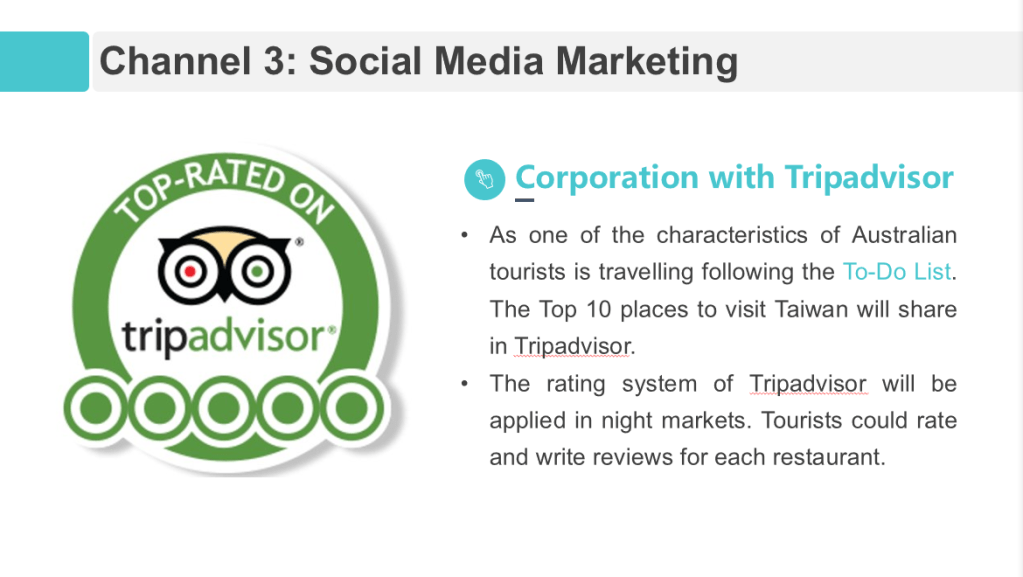
For example, after exploring the digital business model of Tripadvisor, I found how powerful it is to assist hotels and restaurant marketing. Therefore, when I plan a destination marketing in BEMM374 Tourism Marketing, I chose Tripadvisor as the channel of social media marketing.
It is definitely a special and beneficial experience. Thanks for accompanying. Goodbye, my fellow students.
In recent years, digital platforms play a significant role in the global sharing economy. Airbnb, Booking, Tripadvisor, as three giants in the tourism industry, act intermediaries controlling and profiting from most transactions (Gössling & Hall, 2018). Today, let us have a better understanding of the Online Travel Agency (OTA) Pioneer – Tripadvisor.
The Tripadvisor logo
Development of Tripadvisor
Tripadvisor Inc., an online travel company found in the US in 2000, operates a global platform with user-generated content, price comparison tools, and online reservations for transportation, lodging, travel experiences, and restaurants (“TripAdvisor”, n.d., para.1). It has more than 465 million reviews together with restaurant, hotel and tourist attraction options with 315 million members (Marketing91, 2019). Here is a video introducing Tripadvisor.
TripAdvisor Review – Online Travel Services (Watch the Review, 2019)
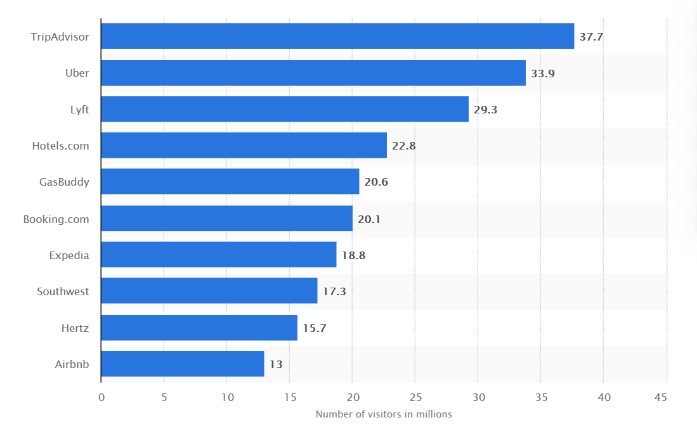
In the beginning, three founders of Tripadvisor would like to build a travel information platform, resources of which are through more traditional channels such as newspapers, guidebooks, magazines, etc. With the growth of digitalization, yet, they gradually realised that sharing visitor reviews is the most popular function of Tripadvisor. After grasping this selling point and combining other functions, Tripadvisor became the first OTA pioneer in the tourism industry and the most popular travel websites in the US. In 2018, the revenue of Tripadvisor is 1.62 billion dollars, occupying 4.65% of worldwide OTA revenue (Lock, 2019).
Most popular travel properties in the United States as of April 2018 by monthly users (in millions) (Clement, 2019)
How Tripadvisor makes money?
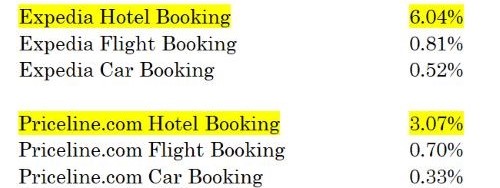
The main source of revenue for Tripadvisor is from advertisements (Marketing91, 2019). For the users, because of all travel comments shared by visitors, it is free to access the majority of functions such as reading travelling stories, searching restaurants and reservations. For tourism corporations, Tripadvisor is an effective marketing platform, as the rich travel content attracts numerous tourists’ attention, especially those whose income in middle and high levels. Therefore, companies with products that of target marketing is the same as the character of Tripadvisor’s users would rent advertisement space from Tripadvisor. Taking an example of Expedia and Priceline, Tripadvisor contributes the high customer flow to the hotel booking.
Percentage of Traffic from Tripadvisor to Booking Conformation Page in 2017 (Pinchain, 2018)
Why it is successful in the tourism industry?
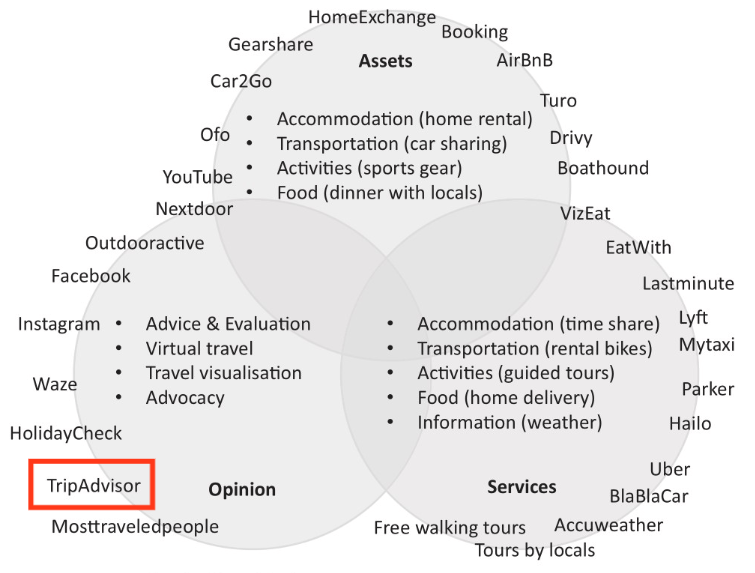
The main reason for Tripadvisor operating successfully may attribute to it obeys sharing economy and the term of “SMAC”, which are the building blocks of digital transformation comprised by four factors (Olenski, 2016).
Sharing economy and Tripadvisor building block (Gössling & Hall, 2018)
* Social Media Platform
Realiable guest feedbasks (Tripadvisor, 2015)
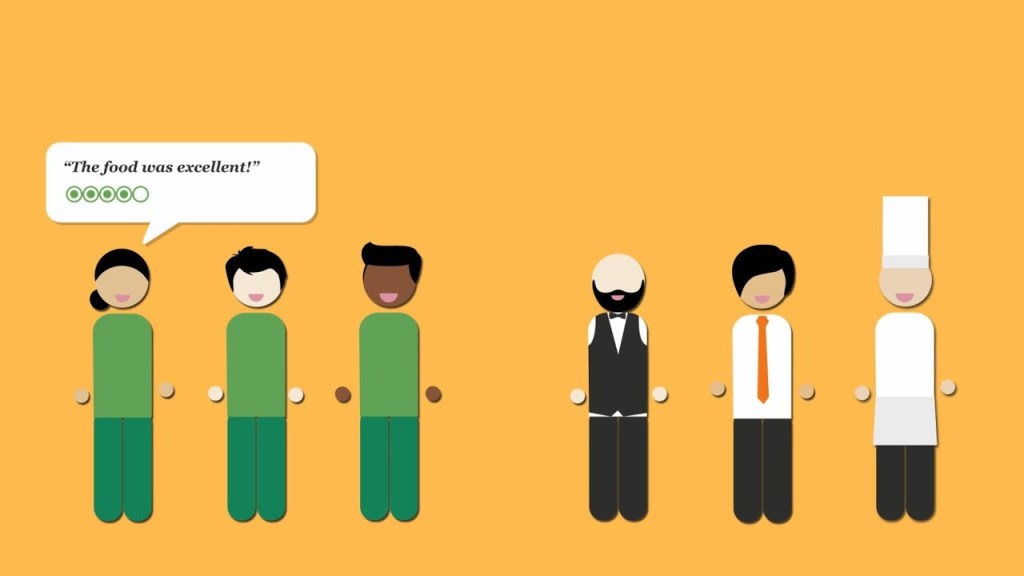
Creating a free communication platform for users is the most significant successful point of Tripadvisor. Initially, it ensures the reliability of guests’ comments. Once visitors consume their reservation, they will have the right to rate their experience and write feedbacks. It also creates a community for users to share their travelling photos, tips and stories. In order to ensure the reliability of guest feedbacks, the company employs quality assurance measures to try and make sure that only authentic data and reviews are posted on its site; however, it could not totally prevent malicious negative comments. Besides, another benefit is that potential travellers could make their own decision through different feedbacks.
Moreover, Tripadvisor effectively uses human psychology that people tend to prefer “wisdom from friends” rather than “wisdom from cold score” (Narayanan, 2015). Once users link their Tripadvisor and Facebook account together and look up reviews of a hotel, the reviews posted by users’ Facebook friends will appear right on top, even though it perhaps not protects privacy since someone may unlike reporting his or her travelling trace to acquaintances.
The power of reviews – according to tripadvisor travellers (Tripadvisor, 2015)
* Mobile technologies
Tripadvisor’s target clients are all the travel enthusiasts who use any operating system device to seek for online help as far as travel services are concerned. Therefore, it developed application systems that are compatible with all the major operating systems namely windows computers, windows phones, android OS and iOS. Moreover, the company internationally operates and localises websites in places such as China, Canada, Thailand, Turkey, Spain, the UK among others.
* Analytics
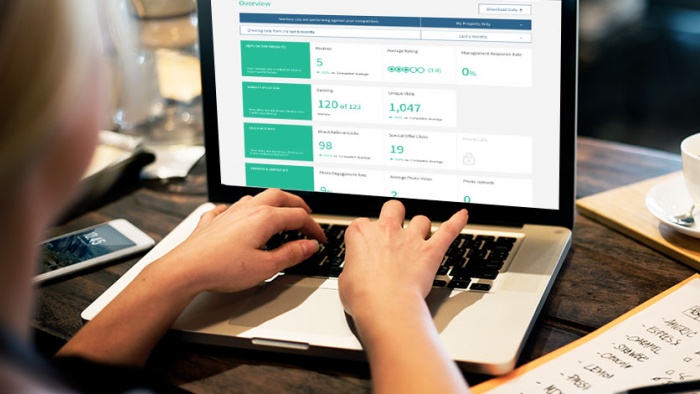
The interface of TripAdvisor analytics (Tripadvisor, 2020)
For businesses, Tripadvisor Business Advantage, a subscription service, assists businesses better market their property to potential guests and connect them to their direct booking channels. The subscriber could access the TripAdvisor analytics to (1) assess performance at a glance, (2) benchmark the performance against competitors, (3) monitor online reputation, (4) track traffic and rankings in business market, (5) find out what travellers are clicking on, etc. (Tripadvisor, 2020). For tourists, the price comparison tool helps them make better decision, even though it would make users spending more time on selection.
* Cloud-based technology services
It is easier for Tripadvisor users to reserve the travelling posts that they like in their accounts. Moreover, when they use the same account to log in Tripadvisor through different devices, their favorite posts are still there.
Tripadvisor is the pioneer of OTA, the digital business model of which attributes to it standing at the top. Although the revenue of its competitors, Airbnb and Booking.com, have been higher than Tripadvisor’s in 2019, these three have different advantages in the tourism industry. For Tripadvisor, it may find methods to increase income; however, the platform of sharing tourist reviews and assist tourism firms marketing and analysing is difficult to be imitated.
Gössling, S., & Michael Hall, C. (2019). Sharing versus collaborative economy: how to align ICT developments and the SDGs in tourism?. Journal of Sustainable Tourism, 27(1), 74-96. doi: 10.1080/09669582.2018.1560455.
Tripadvisor. (2015, October 27). Get the latest facts on the power of reviews…all in under 90 seconds [Video file]. Retrieved from https://www.youtube.com/watch?v=vr6q3PTNnQk
With the growth of digitalisation, there are numerous technological innovations applied in the tourism industry, such as intelligent hotels, robot service and VR experience. People pay more attention to how the digitalisation brings the novel experience for guests; however, it has relatively changed the task of front-line hotel staffs. In my opinion, the digital economy makes hotel employees working more convenient and effective, rather than replacing their jobs.
Hotel TV series – The Halcyon
Effective external service
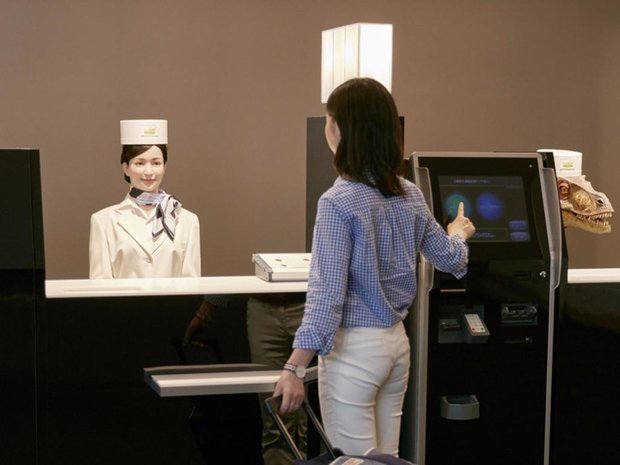
Hotel Robot with the self-service system, a typical example of AI technology applying the hotel industry, improves work efficiency. For the front desk department, the self-check-in robot reduces receptionist work stress during peak time. Generally, the service standard of check-in is 5 minutes per walk-in guest, however, a self-check-in robot merely needs 3 minutes (Pingitore, Huang, & Greif, 2013). That means with the hotel robot assisting, the work efficiency is improved. Moreover, it also changes the task of receptionists who not only work in the front desk, but also introduce how to use the self-check-in system to guests. Click the photo, you will see the how robot helping guests check-in.
The first self-check-in robot appeared in a Japanese hotel named the Weird Hotel in 2015 (Wall Street Journal, 2015)
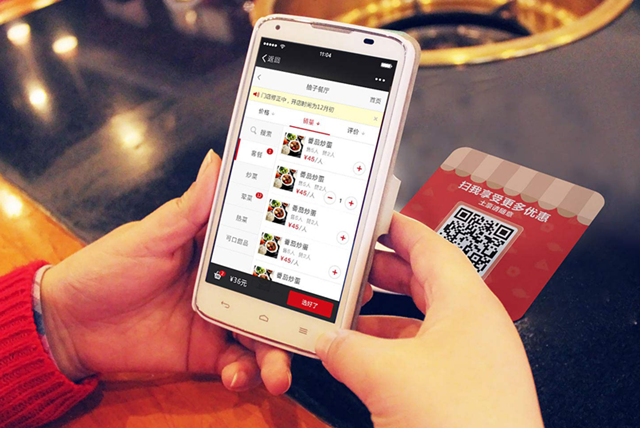
Guests scan the code on the table by their smart phone to order food (CDNdata, 2018)
For the food and beverage department, the ordering tasks for waiters and waitress are likely to be reduced, because of the digital platform of self-ordering. It is a common situation that guests order food through scanning the code on the table in China. And the main work for restaurant staffs is leading guests to the table and serving the dishes.
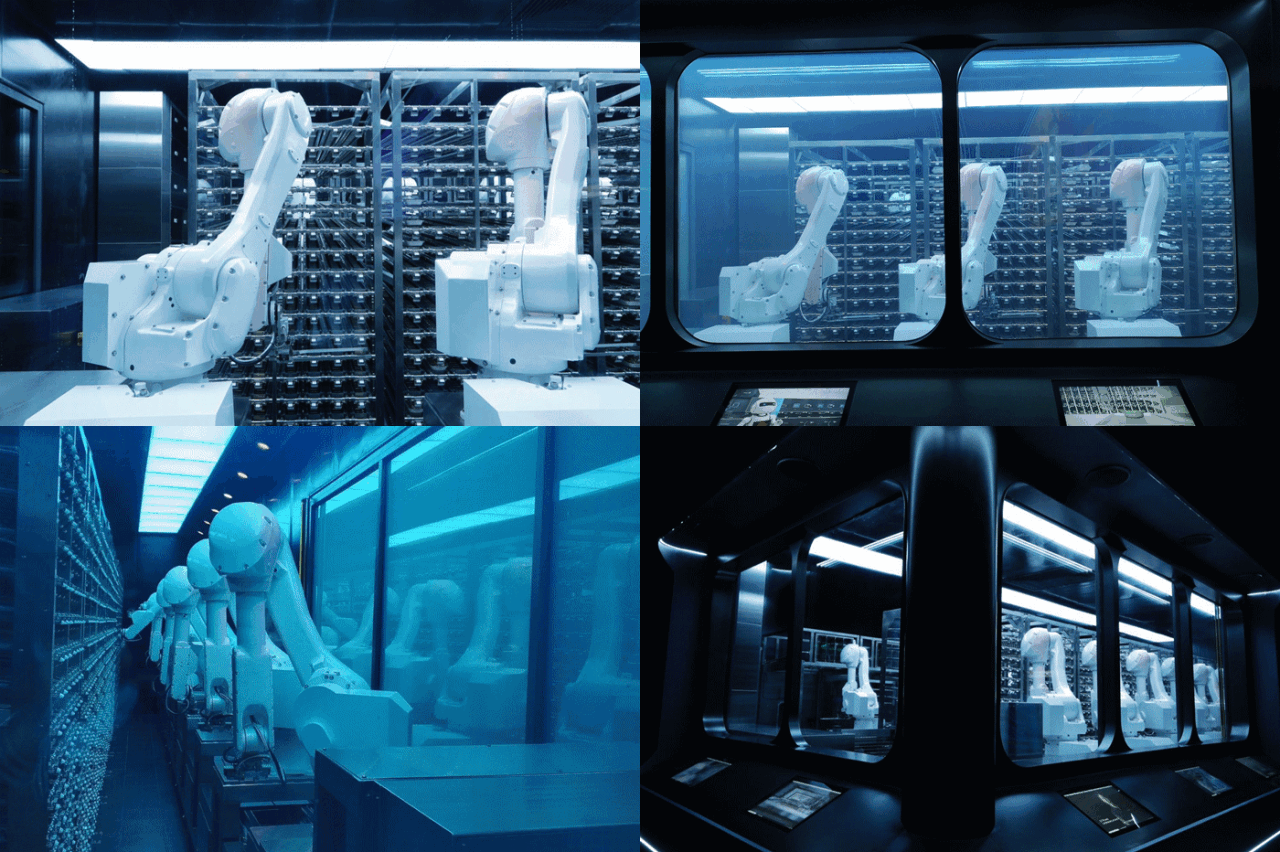
Robot kitchen hand in Haidilao Hotpot in Beijing It could cut back on 37% of kitchen labour cost. (goodyfeed, 2019)
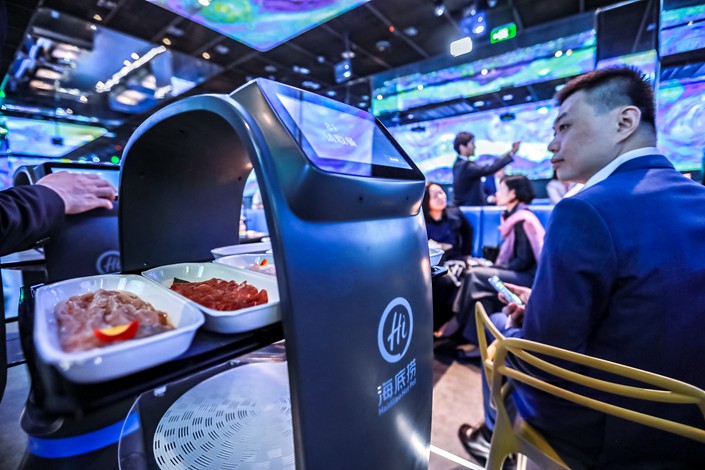
A food-delivery robot in Haidilao Hotpot in Beijing (Caixin, 2018)
Convenient internal communication
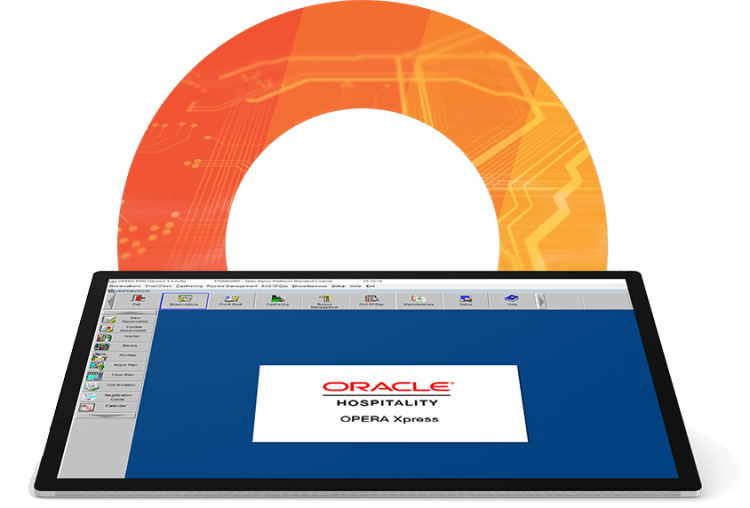
The Opera Hotel Management System (PROTEL, 2019)
The digital platform helps hotel staffs to manage customer information and makes internal communication between employees more convenient. Most international hotels use Opera Hotel Management System (PMS), which is a platform to manage guest information, such as reservation, check-in and check-out and provide the newest room information between front desk, marketing and housekeeping department (PROTEL, 2019); however, a professional reservation system seems to be less applying in hotel restaurants.
From my experience, when I did the internship in the Intercontinental Hotel in Nanjing, China in 2017, making notes on the department notebooks was used to record reservation at the beginning, however, it is easily lost and couldn’t share the information with the marketing department. It is a kind of time-wasting that when marketers planned an event for their clients, they had to call the restaurant to ensure whether the table is available. Recently, the Table Management System (TMS) has been applied, once employees log in it, the updated reservation information could be found.
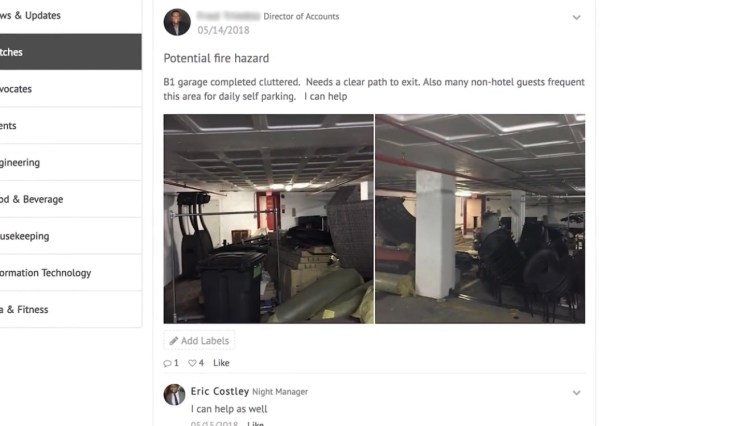
What is more, the digitalisation makes hotel employees more productivity and reduces miscommunication. One of typical example is Beekeeper, which is an app for hotel internal communication (Zamolo, 2019). Staffs thought that this digital platform makes them easily connect with colleagues, get more information and engage with their company.
Hotel staffs could use Beekeeper to report maintenance immedately (Zamolo, 2019)
Here is the marketing video of Beekeeper. You will find more hotel staffs experience about this app.
Why hotel employees love the Beekeeper app? (Zamolo, 2019)
How about the future?
For the future, with the development of the digital economy, the AI technology may replace a part of the workforce; however, it does not mean the hotel employees would be replaced.
In terms of different types of hotels, there are two probably changes in work for hotel employees. For staffs who work in the front-line in a smart hotel, especially the hotel market target is millennials, staffs tend to transfer their work from traditional service to assist guest use self-service robot and maintain the system and equipment. Moreover, with the cheaper cost of equipment and higher that of labour, the employment demand may decrease in the future. Yet, because the robot cost and maintenance charge are higher than the cost of human resource cost at present, this assumption should be further researched.
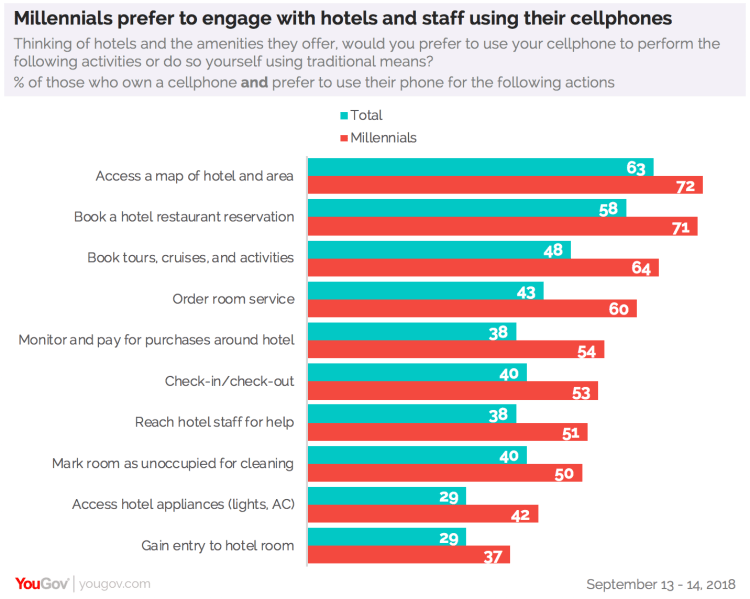
For the luxury hotel, the digitalisation would make hotel employees working more productive and convenient through building different digital platforms, rather than replace their jobs, as customer service is a critical component. According to the study of YouGov, it has shown except millennials, most people from the US tend to experience hotel services in-person or through traditional means, rather than use a cellphone to do so (YouGov, 2018).
Millennials prefer to engage with hotels and staff using their cellphones in 2018 (YouGov, 2018)
What is more, taking an example of the Hilton hotel, the primary customer and the bulk of their revenue is not from millennials (Alumni, 2016). Therefore, people working in the luxury hotels are likely to do the traditional service and pay more attention to improve the service quality, such as offering personalized service, as well as, their work will more effective with the assistant of digital platforms, such as managing guest information, recording food freshness, control supply chain automatically.
To summary, the digitalisation would change the work task continually; however, as O’Halloran emphasised in 2018 that “Technology does not need to simply replace humans, it can and always has enhanced what we do, who we are and the way we do things.” It is significant that, as hotel employees, the reason why new technologies applied in the background of the digital economy is offering high-quality service and making guest enjoying their hotel experience, rather than job replacement.
Pingitore, G., Huang, W., & Greif, S. (2013). Lost in translation: Cross-country differences in hotel guest satisfaction [Electronic article]. Cornell Hospitality Industry Perspectives, 3(2), 6-14.



 Emma's blog :)