With the growth of digitalisation, there are numerous technological innovations applied in the tourism industry, such as intelligent hotels, robot service and VR experience. People pay more attention to how the digitalisation brings the novel experience for guests; however, it has relatively changed the task of front-line hotel staffs. In my opinion, the digital economy makes hotel employees working more convenient and effective, rather than replacing their jobs.

Effective external service
Hotel Robot with the self-service system, a typical example of AI technology applying the hotel industry, improves work efficiency. For the front desk department, the self-check-in robot reduces receptionist work stress during peak time. Generally, the service standard of check-in is 5 minutes per walk-in guest, however, a self-check-in robot merely needs 3 minutes (Pingitore, Huang, & Greif, 2013). That means with the hotel robot assisting, the work efficiency is improved. Moreover, it also changes the task of receptionists who not only work in the front desk, but also introduce how to use the self-check-in system to guests. Click the photo, you will see the how robot helping guests check-in.
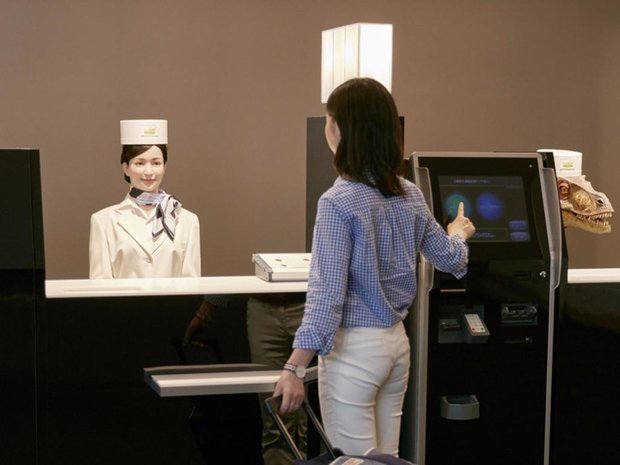
named the Weird Hotel in 2015 (Wall Street Journal, 2015)
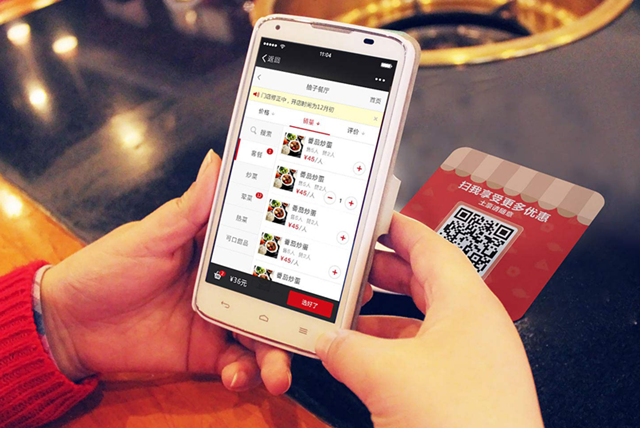
For the food and beverage department, the ordering tasks for waiters and waitress are likely to be reduced, because of the digital platform of self-ordering. It is a common situation that guests order food through scanning the code on the table in China. And the main work for restaurant staffs is leading guests to the table and serving the dishes.
Besides, Haidilao Hotpot, the Chinese biggest hotpot restaurant, started to try to deliver meals by a robot in Beijing in 2019 that means staffs would focus on offering individualised service rather than repetitive work. Here is a video about Haidilao robot reported by BBC News (BBC News, 2019).
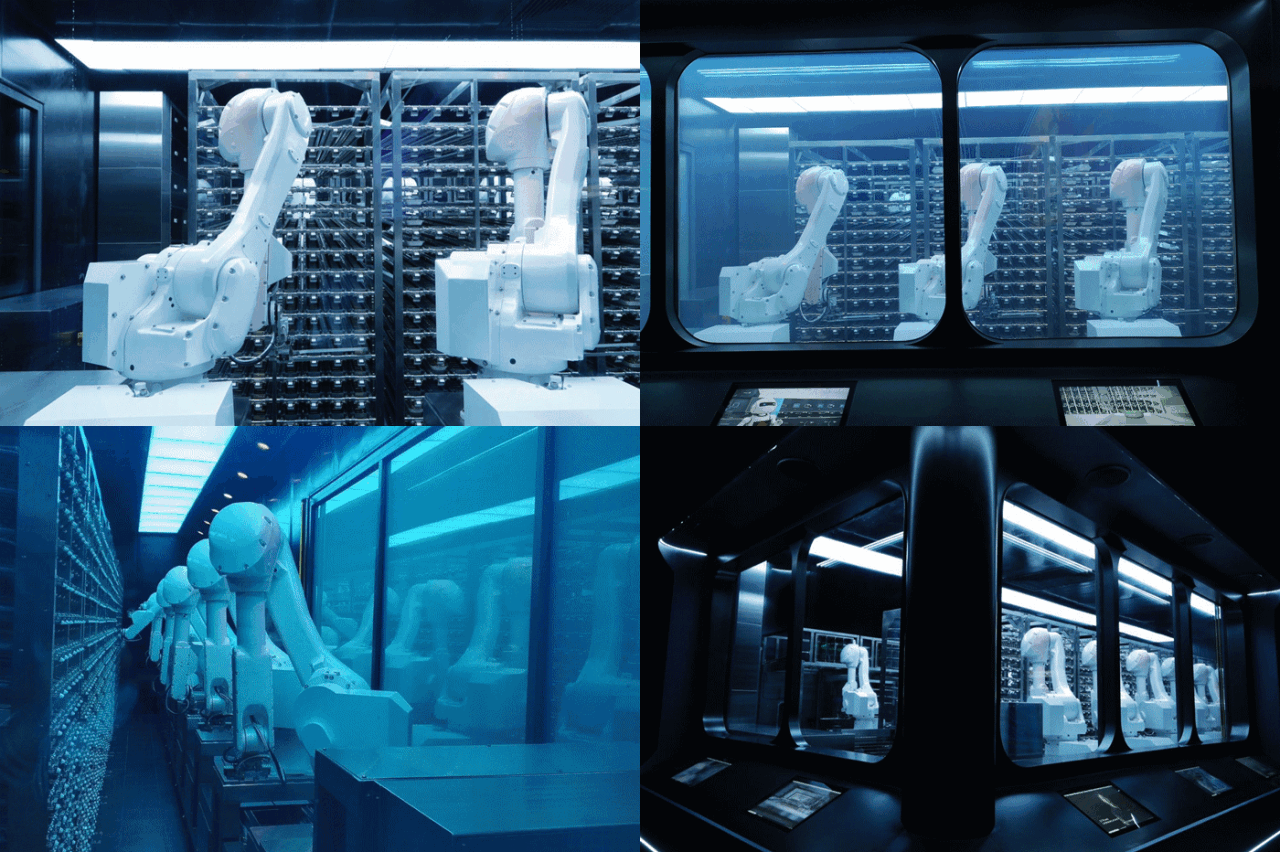
It could cut back on 37% of kitchen labour cost.
(goodyfeed, 2019)
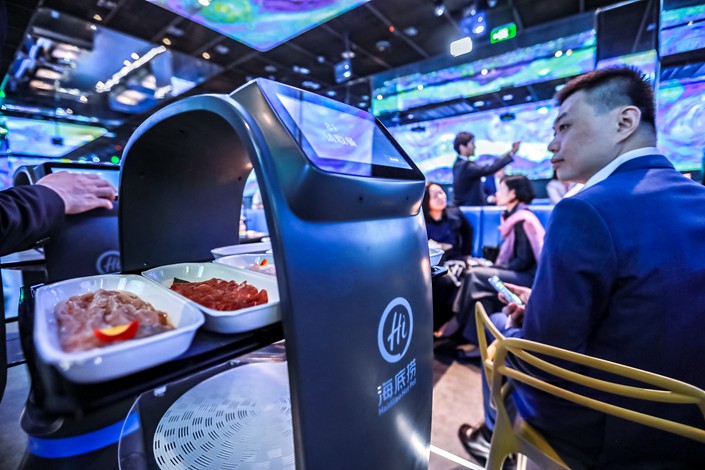
(Caixin, 2018)
Convenient internal communication

(PROTEL, 2019)
The digital platform helps hotel staffs to manage customer information and makes internal communication between employees more convenient. Most international hotels use Opera Hotel Management System (PMS), which is a platform to manage guest information, such as reservation, check-in and check-out and provide the newest room information between front desk, marketing and housekeeping department (PROTEL, 2019); however, a professional reservation system seems to be less applying in hotel restaurants.
From my experience, when I did the internship in the Intercontinental Hotel in Nanjing, China in 2017, making notes on the department notebooks was used to record reservation at the beginning, however, it is easily lost and couldn’t share the information with the marketing department. It is a kind of time-wasting that when marketers planned an event for their clients, they had to call the restaurant to ensure whether the table is available. Recently, the Table Management System (TMS) has been applied, once employees log in it, the updated reservation information could be found.
What is more, the digitalisation makes hotel employees more productivity and reduces miscommunication. One of typical example is Beekeeper, which is an app for hotel internal communication (Zamolo, 2019). Staffs thought that this digital platform makes them easily connect with colleagues, get more information and engage with their company.
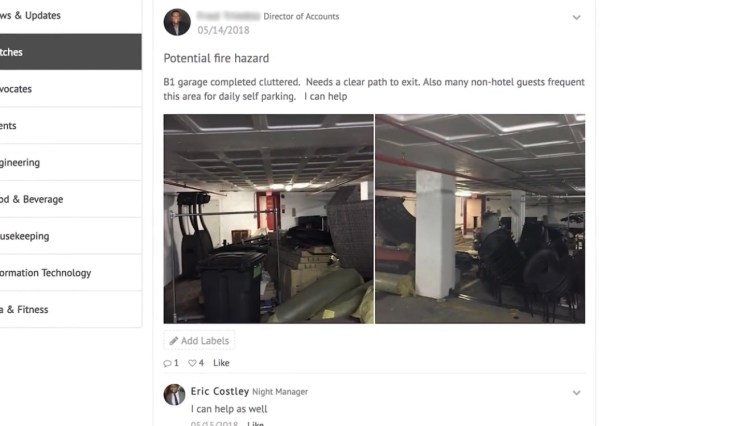
(Zamolo, 2019)
Here is the marketing video of Beekeeper. You will find more hotel staffs experience about this app.
How about the future?
For the future, with the development of the digital economy, the AI technology may replace a part of the workforce; however, it does not mean the hotel employees would be replaced.
In terms of different types of hotels, there are two probably changes in work for hotel employees. For staffs who work in the front-line in a smart hotel, especially the hotel market target is millennials, staffs tend to transfer their work from traditional service to assist guest use self-service robot and maintain the system and equipment. Moreover, with the cheaper cost of equipment and higher that of labour, the employment demand may decrease in the future. Yet, because the robot cost and maintenance charge are higher than the cost of human resource cost at present, this assumption should be further researched.
For the luxury hotel, the digitalisation would make hotel employees working more productive and convenient through building different digital platforms, rather than replace their jobs, as customer service is a critical component. According to the study of YouGov, it has shown except millennials, most people from the US tend to experience hotel services in-person or through traditional means, rather than use a cellphone to do so (YouGov, 2018).
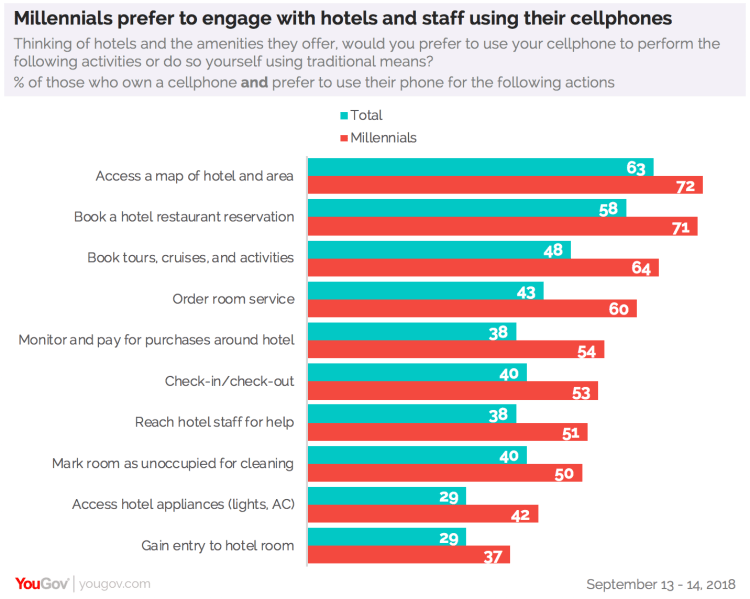
What is more, taking an example of the Hilton hotel, the primary customer and the bulk of their revenue is not from millennials (Alumni, 2016). Therefore, people working in the luxury hotels are likely to do the traditional service and pay more attention to improve the service quality, such as offering personalized service, as well as, their work will more effective with the assistant of digital platforms, such as managing guest information, recording food freshness, control supply chain automatically.
To summary, the digitalisation would change the work task continually; however, as O’Halloran emphasised in 2018 that “Technology does not need to simply replace humans, it can and always has enhanced what we do, who we are and the way we do things.” It is significant that, as hotel employees, the reason why new technologies applied in the background of the digital economy is offering high-quality service and making guest enjoying their hotel experience, rather than job replacement.
References:
BBC News. (2019, February 10). Robots staff China’s top hotpot chain. [Video file]. Retrieved from https://www.youtube.com/watch?v=xGm5RU8610k.
Caixin. (2018). Haidilao Says Food Safety Scandals Behind It With New ‘Smart’ Store. Retrieved October 26, 2018 from https://www.caixinglobal.com/2018-10-26/haidilao-says-rats-roaches-wont-survive-in-its-new-smart-store-101339521.html.
CDNdata. (2018). The report of mobile ordering trends in 2018. Retrieved July 30, 2018 from https://www.cbndata.com/report/977/detail?isReading=report&page=1.
Goodyfeed. (2019). HAIDILAO PLANS TO OPEN AN OUTLET IN S’PORE WITH ROBOTS IN 2019. Retrived from https://goodyfeed.com/haidilao-plans-to-open-an-outlet-in-spore-with-robots-in-2019/.
O’Halloran, G. (2018). Futurelearn Building your career in tomorrow’s workplace: 1.3. Retrived June 18, 2018 from https://www.futurelearn.com/courses/creating-your-future/4/steps/652897
Pingitore, G., Huang, W., & Greif, S. (2013). Lost in translation: Cross-country differences in hotel guest satisfaction [Electronic article]. Cornell Hospitality Industry Perspectives, 3(2), 6-14.
Wall Street Journal. (2015, July 16). A Tour of the World’s First Robot-Staffed Hotel. [Video file]. Retrieved from https://www.youtube.com/watch?v=C6bQHUlq664.
YouGov. (2018). Three in four Americans would pay extra for a flexible check-in schedule. Retrieved September 18, 2018 from https://today.yougov.com/topics/travel/articles-reports/2018/09/18/three-four-americans-would-pay-extra-flexible-chec.
 Emma's blog :)
Having worked in the hospitality industry as well, I agree that digitalisation helps hotel employees to work more efficiently. As you mentioned, technology significantly improves processes such as managing guest information, recording food freshness and control supply chain. Furthermore, I think digitalisation is a crucial part for hotels in order to retain customer’s loyalty and brand advertisement, especially in regard to millennials. However, in regard to the idea that humans can be replaced by robots, there has to be made a difference between the main customer segment of the hotel in terms of leisure or business guests as well. In my opinion, business hotels have to focus on offering more efficient and quick procedures by means of AI and robots whereas leisure hotels have to focus on the high-quality service and making guest enjoying their hotel experience. Often the personal aspect of employees for business people is less relevant as for guests that are on holiday.
LikeLiked by 1 person
Hello, Caroline. It’s happy to meet people working in the same industry. The idea of hotel robot in business hotel makes me recall Fly Zoo Hotel in Hangzhou, China, a smart and business hotel managed by Alibaba Group. Hope this kind of hotel could show us how robots help business guests enjoy more wonderful experiences.
LikeLike
Hi Xingyuan, you made a fantastic blog so that I can not find a word to praise!
You explained the impact of digitalization on the work content of hotel employees form both internal and external aspects, and finally concluded that digitalization only affects the work content of employees to improve their work efficiency. Instead of disappearance of hotel staff positions, for some hotels that focus on personalization and quality of service, human staff are particularly important.
I think that all-smart hotels may have some security risks and privacy leakage risks. For example, traditional hotels will have security guards and logistical personnel to protect customers from accidental damage, but what to do once a smart hotel has a virus attack on hotel systems, power outages and fire disaster.
LikeLike
Hi Emma,
Thank you for bringing brilliant examples of robot-assisted check-in system and self-service ordering platform to our horizon. I have seen the changes you mentioned in hotels and Haidilao and certainly agree with you on how the digitalization ease my ordering, checking-in. Although the robotization is supposed to improve the customer service efficiency, the application of it in some organization can be inflexible, I have encountered situations where some restaurants only provide digital platform service, or that they only accept digital platform payment and do not accept cash, which I think is actually inconvenient for digital-technology-unfriendly groups like the elderly. I guess some enterprises are too keen to keep pace with digital innovation and did not consider certain market segmentations.
However, the digitalization is indeed an inevitable trend which I personally cannot agree more, especially in terms of digitalization inter organizations. Well, it is a big data era with massive customer information, I do think organizations, especially larger scaled ones, must keep pace and introduce efficiency database management system, like what you mentioned, the PMS. This way enterprises may achieve more efficient customer relationship management or internal communication.
Anyway, I loved your post, it offers insight on digitalization in hotels that brings impact from both customer and management sides. I especially like how you demonstrated your case with good examples, data, and linked resources.
LikeLike
Hello Daria
I strongly agree with you that some restaurants may not consider their guest characters and only applying new technology. It sounds like a conflict in this era. Hope they can balance it better.
LikeLike
Hi Xingyuan, really like your blogpost with many interesting examples and excellent design! I’m strongly agree with your idea that digitalisation could not replace human employees but make their works more efficient. Admittedly, the self-service system which has already been applied on hotel industry truely helped reduce the pressure on employees. However, I personally think that the current application of digitalisation in the catering industry is more likely to be a kind of ‘gamification’ of work, the reason that choose robots to order and delivery food might be due to its interestingness and customers may be attracted by these novel artificial intelligence. But whether they will bring convenience to employees’ work still needs further research. Plus, the limitations of AI cannot be denied as well. The current AI technology is not perfect enough to allow robots to communicate with customers more personally and directly, but the future development of digitalision can be predicted to bring tremendous changes to the hotel industry and other industries.
LikeLiked by 1 person
Wow, Yaxin, thank for you bring the critical idea. I strongly agree with you that people would like to enjoy the robot service at present because it’s novel. Indeed, it’s difficult to predict whether it could make waiters’s work more convenient. Let’s wait and see.
LikeLike
Hi, Emma, I am very honored to see your article, so that I could understand the change of the profession of hotel employees in the age of data. Actually, I agree that the digital economy makes the work of hotel staff efficient and flexible. The advent of robots is one of the changes you mentioned in the article. Chatbots are one of the most advantageous electronic trends in the hospitality industry. In an era where the need for information speed is greater than ever, chatbots are definitely a favorite tool for businesses. From customer service inquiries to hotel reservations, chatbots can provide a wide range of services one by one. That is to say, hotel robots can replace the work of hotel staff to a certain extent which can reduce the work pressure of hotel staff during peak hours. But I have a question: Is the emergence and development of robots would make a threat to hotel staff? In my opinion, the gradually intelligent hotel management model will improve the working efficiency of the hotel, but it will also cause some hotel staff’s unemployment problem because artificial intelligence would gradually replace some employees is an obvious trend in the future
LikeLike
Hi Emma,
A pretty inspiring blog to read! I have been interested since you said at the beginning that the digital economy will help hotel employees work more effective instead of replacing their jobs. As you mentioned before, new techniques like Hotel Robot could improve efficiency in respect of external services, and the applying of the digital platform could provide more convenient internal communication. The examples of Weird Hotel and Beekeeper are very persuasive. Generally speaking, I agree with that the emerging of AI technology does not exactly mean we don’t need hotel employees anymore. But the quality of services we expect from hotel employees will experience a huge transformation. As the broader use of digital technologies, lots of repetitive work that are currently manually done may be totally completed by machines in the future. Therefore, employees need to realize the importance of offering personalized and diverse services. Since you mentioned Haidilao Hotpot I have to say I kind of enjoy their cute individualised services and it’s a pity for them to lose such features. Although the cost of digitalization can be an impediment, hotel employees need to be well prepared anyway.
LikeLike